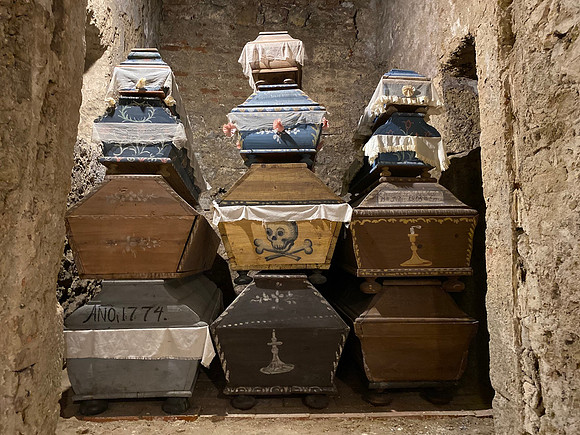
Memento mori Museum, Dominican Church, Vác
Latin for "Remember you have to die"
The exhibit in Vác, Hungary is the result of a mummy bonanza discovered during routine restoration of the town’s Dominican church. In 1994 workers discovered a secret crypt that had been bricked up for over 200 years. Inside, 265 hand-painted coffins were stacked, one on top of the other, in order of size. Inside, the occupants had naturally mummified, due to perfect conditions of temperature and aridity.
It wasn’t simply their bodies that were so well preserved. Everything from the rosaries to the handmade stockings on their feet were equally intact, offering a gold mine for ethnographers on the funerary customs and everyday life of 18th-century Hungarian villages. There was something there for doctors as well: traces of ancient tuberculosis. An Australian surgeon, Dr. Mark Spigelman, has devoted the past 6 years to studying the bacteria found in one mummy in particular, and the information gleaned from this ancient DNA could provide information that will help fight tuberculosis.
The real delight of the mummies exhibited in Vac, Hungary isn’t the shriveled bodies and stretched skin, it is the coffins themselves. A huge selection of the coffins are exhibited, many stacked on top of each other in the same formation they had been found in. Each coffin had been lovingly hand-painted with crucifixes, flowers, quotations, bible verses, angels, skull and crossbones, hourglasses, and Memento Mori inscriptions.